
ABOUT MICHELLE
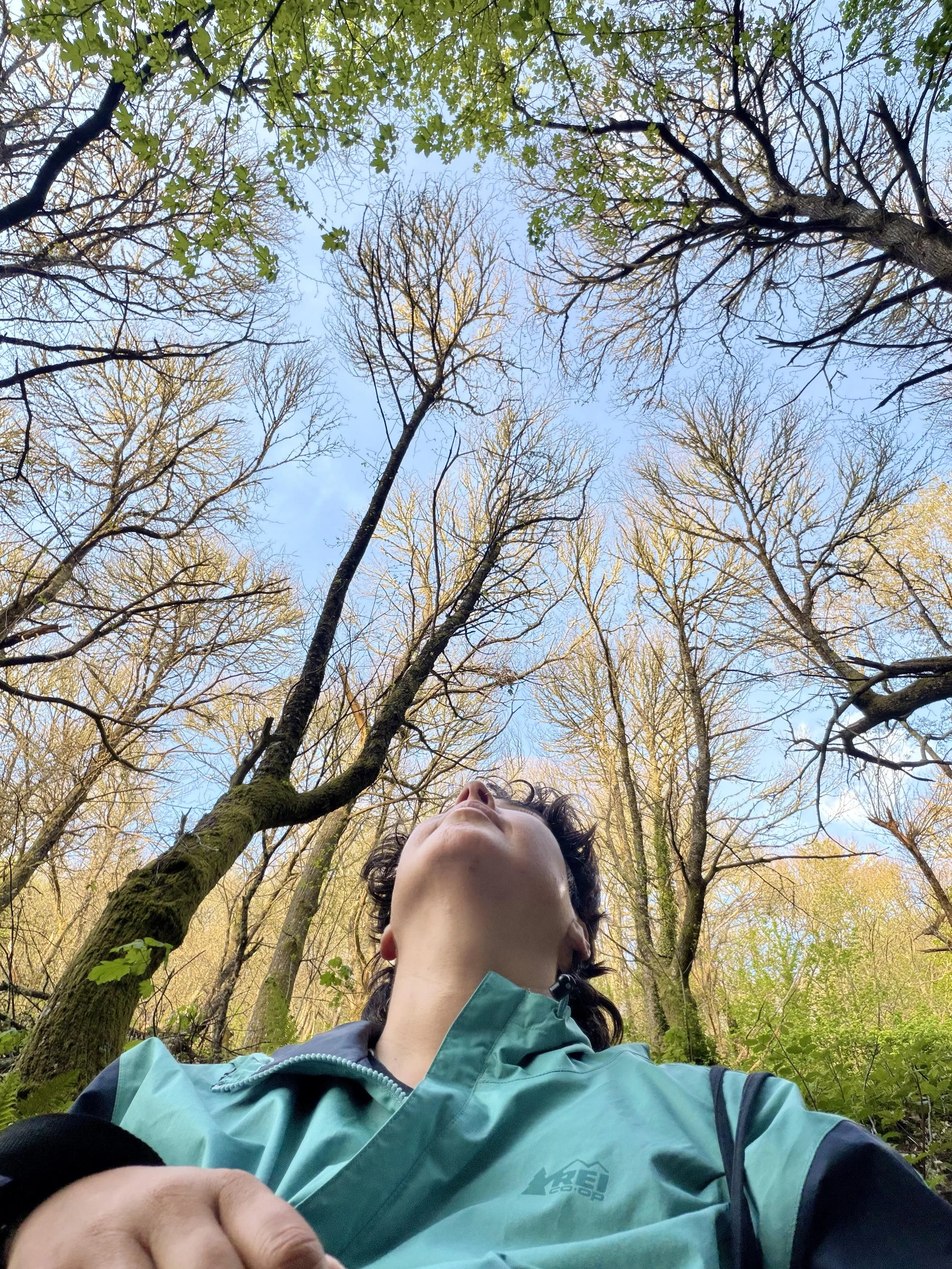
Michelle Carrera is a Puerto Rican writer, grief worker, death doula, and cultural witness exploring grief, ancestry, ecology, spirituality, and belonging in a changing world.
Born and raised in Puerto Rico, Michelle spent years moving between places, communities, and identities before returning home to the island. Along the way, she founded mutual aid projects, worked in animal advocacy and sanctuary, accompanied people through grief and dying, researched family histories, walked hundreds of miles on pilgrimage, and became increasingly interested in the ways humans make meaning in times of loss and transformation.
Today, her work moves across essays, speculative fiction, grief education, archival research, and spiritual inquiry. She is particularly drawn to questions of memory, inheritance, migration, ecological belonging, and how we remain open-hearted in a world marked by uncertainty and change.
Her writing has appeared in publications including Planted Journal and collaborative works such as Compassion in Crisis: Building Disaster-Resilient Communities, where she explored death doula work through the lens of mutual aid and collective care. Her work can also be found through Grief and Liberation, Monday Mournings, The Underground Dispatch, and Unclaimed Ancestors.
TRAINING & LINEAGE
Michelle's work is informed by years of study, practice, accompaniment, and lived experience.
Death Doula Training through Doorway Into Light with Bodhi Be and Ram Dass
Grief Educator Training with David Kessler
Interfaith Animal Chaplaincy through Compassion Consortium
Loving, Dying, and Letting Go through the Institute for the Study of Birth, Breath, and Death
These trainings inform her approach, but some of her deepest teachers have been grief itself, the dying and bereaved, pilgrimage, ancestry, forests, oceans, animals, and the communities she has been fortunate to serve alongside.
ABOUT GRIEF AND LIBERATION
Grief and Liberation is a creative ecosystem devoted to grief, death, belonging, and the search for aliveness in fractured times.
Here you will find essays, stories, reflections, and projects that take seriously what much of our culture asks us to move past too quickly: loss, ecological mourning, ancestral inheritance, diaspora, longing, and the slow work of returning to what is real. The work moves across the personal and the political, the spiritual and the embodied, the ancient and the urgently present.
It is rooted in a simple conviction: that grief, when met honestly and in community, does not diminish us. It expands our capacity for love, relationship, and attention. It reminds us that we belong to one another, to place, to memory, and to the living world itself.


Grief & Loss
Ancestry & Memory

Ecology & the More-Than-Human
Some of the threads that shape my work:
Interested in collaborating, inviting me to speak, commissioning a project, or bringing Write Your Grief to your organization?

Pilgrimage & Place

Spirituality & Liberation

Animals & Sanctuary

Writing & Story
Community & Mutual Aid


We do not heal in isolation.
We become free together.