
The Geometry of Chosen Family
The mangroves don't care about straight lines.
At high tide, the sea slips beneath them, around roots that arch, split, and disappear into the water, then emerge some place else entirely. There’s no obvious beginning. No central trunk commanding the others. Each root grows toward another, around it, alongside it until it stops looking like a stand of trees and starts looking like a relationship.
Schools of juvenile French grunts flicker under the roots, each fish turning almost simultaneously. Young schoolmaster snappers shelter in the prop roots, where the roots intertwine too tightly for larger predators to follow. Mangrove oysters fasten themselves directly onto the roots, filtering the tide. Nothing here survives by standing apart. Every life seems to make room for another.
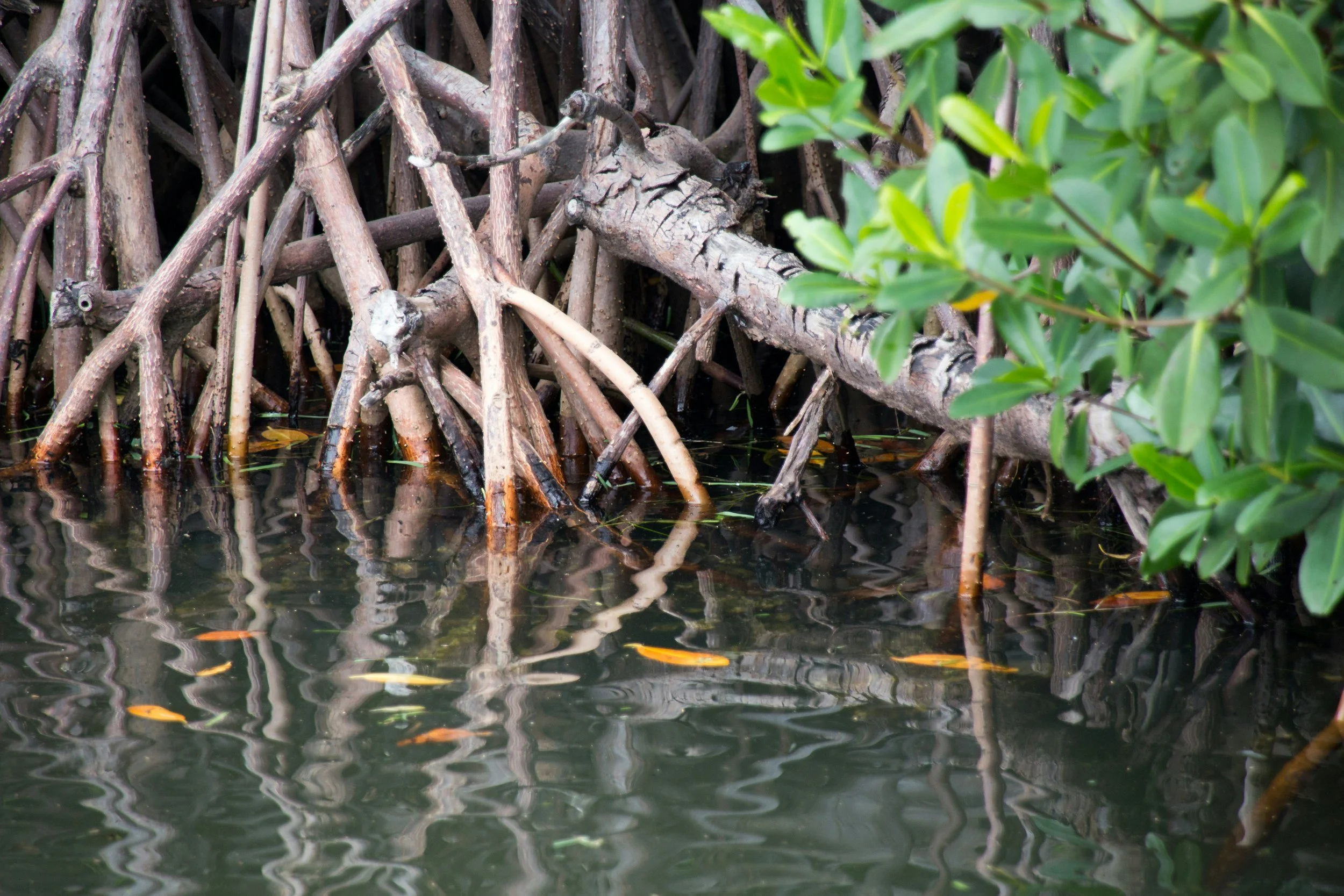
Living on the western coast of Puerto Rico, I've begun to imagine that every landscape has its own mathematics. The desert practices distance. Rivers practice persistence, mile after mile of it. Coral reefs are solving for accumulation, every tiny life leaving behind just enough for the next one to build on. Mangrove forests practice something closer to mutual support, a force distributed across countless points so that no single root ever has to hold the full weight of the tide alone.
The living world has always been making these calculations. We just don’t pay close enough attention. It made me wonder why, when us humans decided to draw a family, we chose a line.
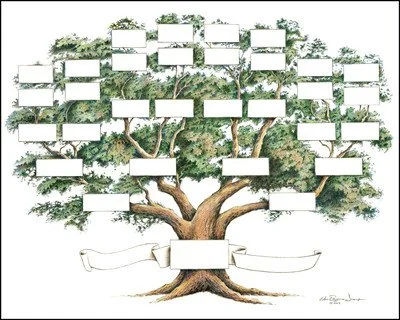
Sometimes we dressed it up as a tree, but it remained a line all the same. Parents above. Children below. Generation after generation extending in one direction. It’s an elegant diagram, useful for tracing inheritance and last names and who begat whom. But did we mistake one drawing for reality itself?
The family tree may not be the geometry of kinship at all. Only one geometry among many.
I've always been preoccupied with ancestry. Just this Spring, I crossed an ocean and walked five hundred miles following a man who died centuries before I was born. I've spent whole afternoons bent over parish records, tracing loops of ink. Every new name I recover feels as if discovering a new person inside myself, like knowing myself a little better.
I still feel that pull. I still want to know where I come from.
The family tree has given me gifts I wouldn't trade. It’s taught me that I belong to migrations, to languages, to people embedded in my very cells. I still love the line. I just don't think it's the whole drawing.
The mangroves have already warned me against looking for its replacement, too. Don’t just swap one universal shape for another, they say. A reef doesn't organize itself the way a forest does. A river doesn't move the way a mycelial network does. A flock of shorebirds crossing the evening sky has a geometry that exists only in the instant each bird responds to the bodies around them, gone the moment the flock lands. There may be no single shape underneath all this. Just an enormous, ongoing improvisation that just so happens to look like order from far enough away.
Ecology is the study of relationships, not individual lives. I find myself wondering whether geometry is too. I'm not a mathematician. I never did especially well in math class. But the question won't quite let me go.
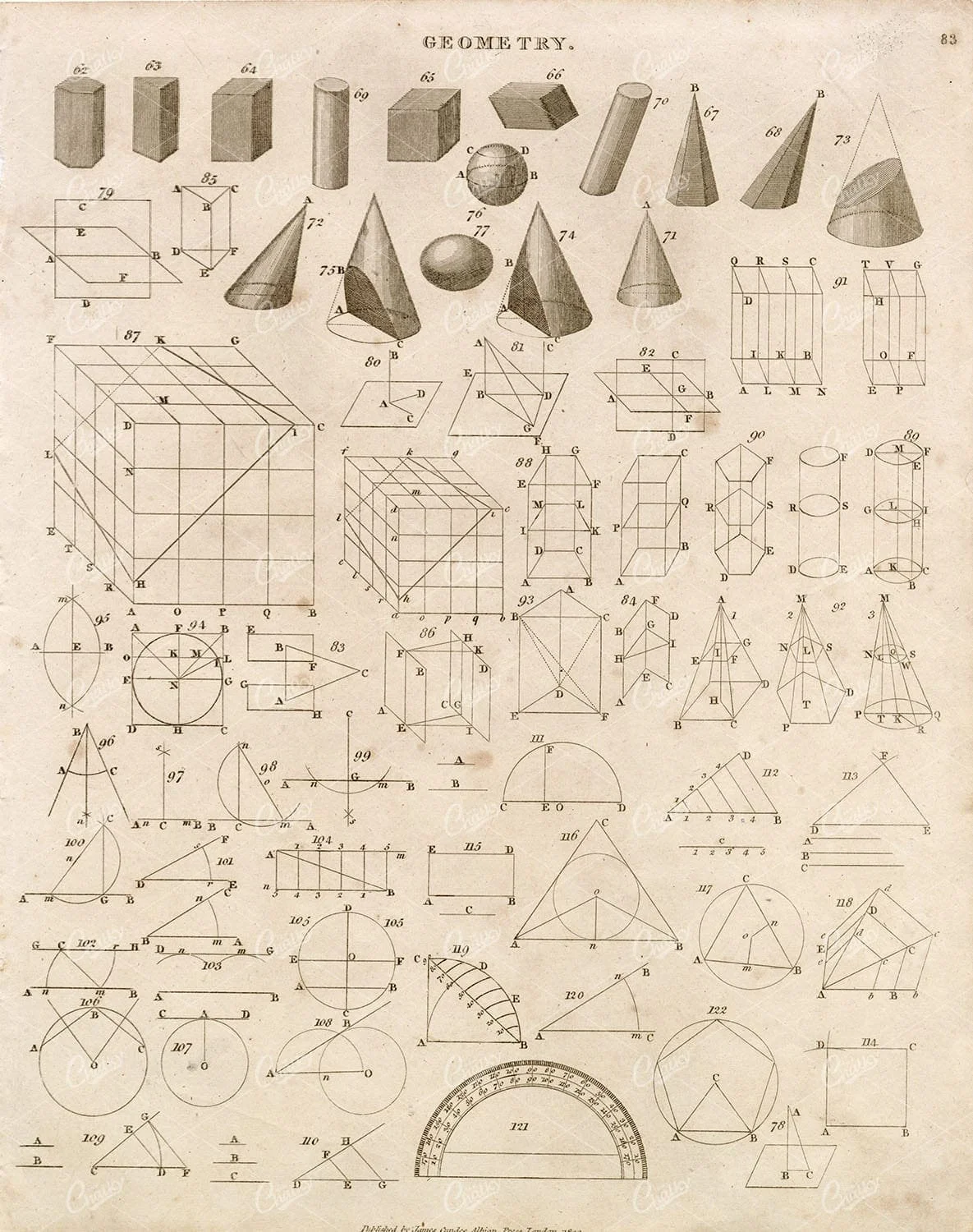
A point, by itself, is almost nothing. Geometry begins only when a second point appears. A line is just two points that decided to stay close. Add a third, and weight can be shared in ways two points never could. Looked at this way, shapes are more like agreements than objects. They are a record of how weight moves between bodies.
That has begun to change how I think about care. Sitting beside people who are dying has complicated my understanding of relationship more than anything else ever has.
At the bedside, love rarely organizes itself according to official diagrams. I've watched lifelong friends keep vigil while relatives stayed away. I've seen neighbors entrusted with someone's final wishes. I've heard a dying man call out for the woman who raised him, though every form in the hospital filed her as "no relation." Love keeps drawing lines that the paperwork cannot predict, in directions no form has a field for.
Care has its own topology, maybe. It bends around absence, stretches across distance, and does things no straight line could. What it won't do is stay inside the boxes we keep building for it.
I kept wondering what shape chosen family was. A web? A constellation? The intertwined roots of a mangrove? Geometry isn’t only about what something looks like. It’s about how something holds together and who’s doing the holding. The geometry of chosen family isn’t defined by a single shape. It’s defined by the movement of care. Its lines are allowed to multiply, overlap, circle back, and change direction. Friends become siblings. Students become teachers. Children become caregivers. The form changes. The holding remains.
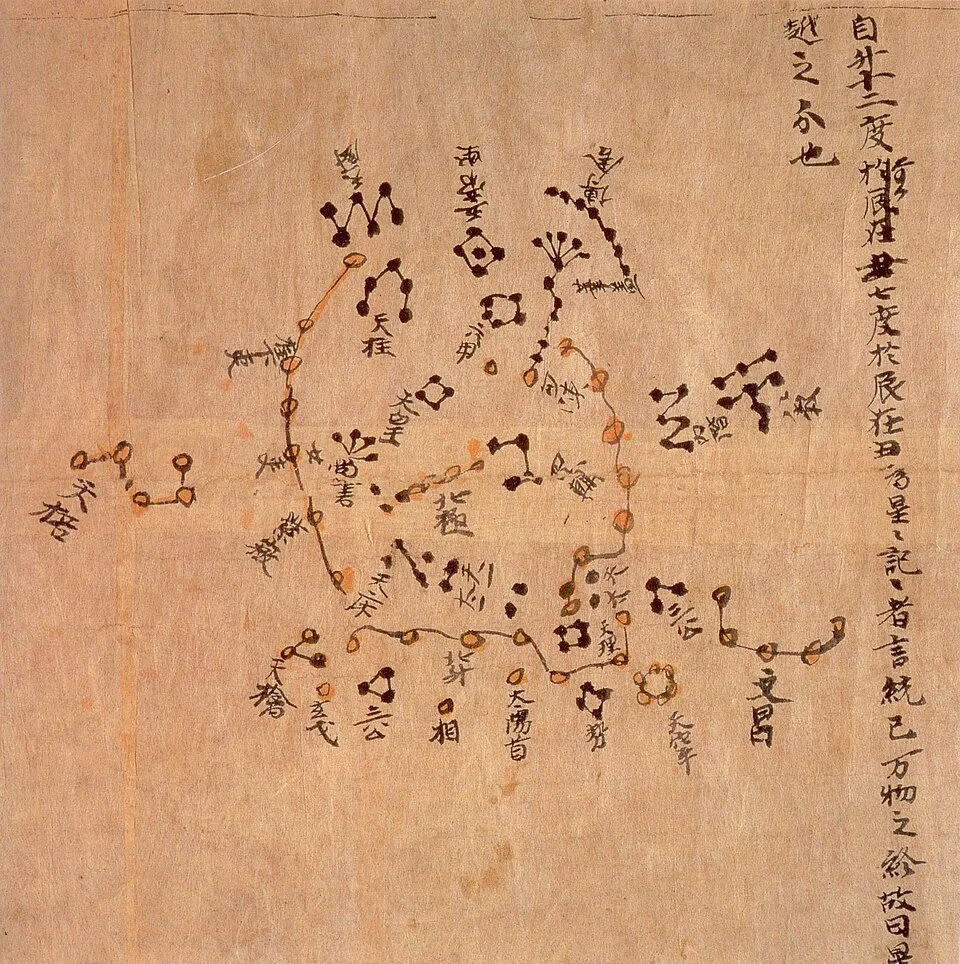
Dunhuang star map
The mangroves aren't trying to explain any of this to me. A reef isn't standing in for human intimacy, and I try to remember that. The living world doesn't exist to hand us metaphors on request. It just keeps demonstrating, whether I'm watching or not, that relationship has always been one of its greatest creative forces. That survival is often collective and that resilience is rarely held by one point alone.
It was only after sitting with that for a long while that I started looking differently at the phrase chosen family. For years I thought it described an alternative. That this beautiful improvisation which was born out of exclusion, was something we built because we'd been left off the original design. I've come around to a different read.
We didn't invent another way of belonging. We were simply paying close enough attention to notice one that had been here the whole time, waiting under the water like a root.
The living world has never organized itself around lineage the way we did. Ask a mangrove which root came first, and the question barely makes sense. A coral colony has no founding polyp to give credit to. Shorebirds wheel across the sky without a leader, and a mycelial network underground has never once paused to check whose spore got there first. What these systems care about instead is simpler and harder: who's connected to whom, and how the weight gets carried.
Queer communities became extraordinary builders of kinship for a specific reason. So many of us had to become intentional students of relationship, on purpose, by necessity. We learned, the slow way, what the beyond-than-human world has been practicing for millions of years: that survival is collective more often than it's solitary, that care travels sideways just as easily as it travels down a family line, and that no single life holds itself together without a great many others quietly bracing it from underneath.
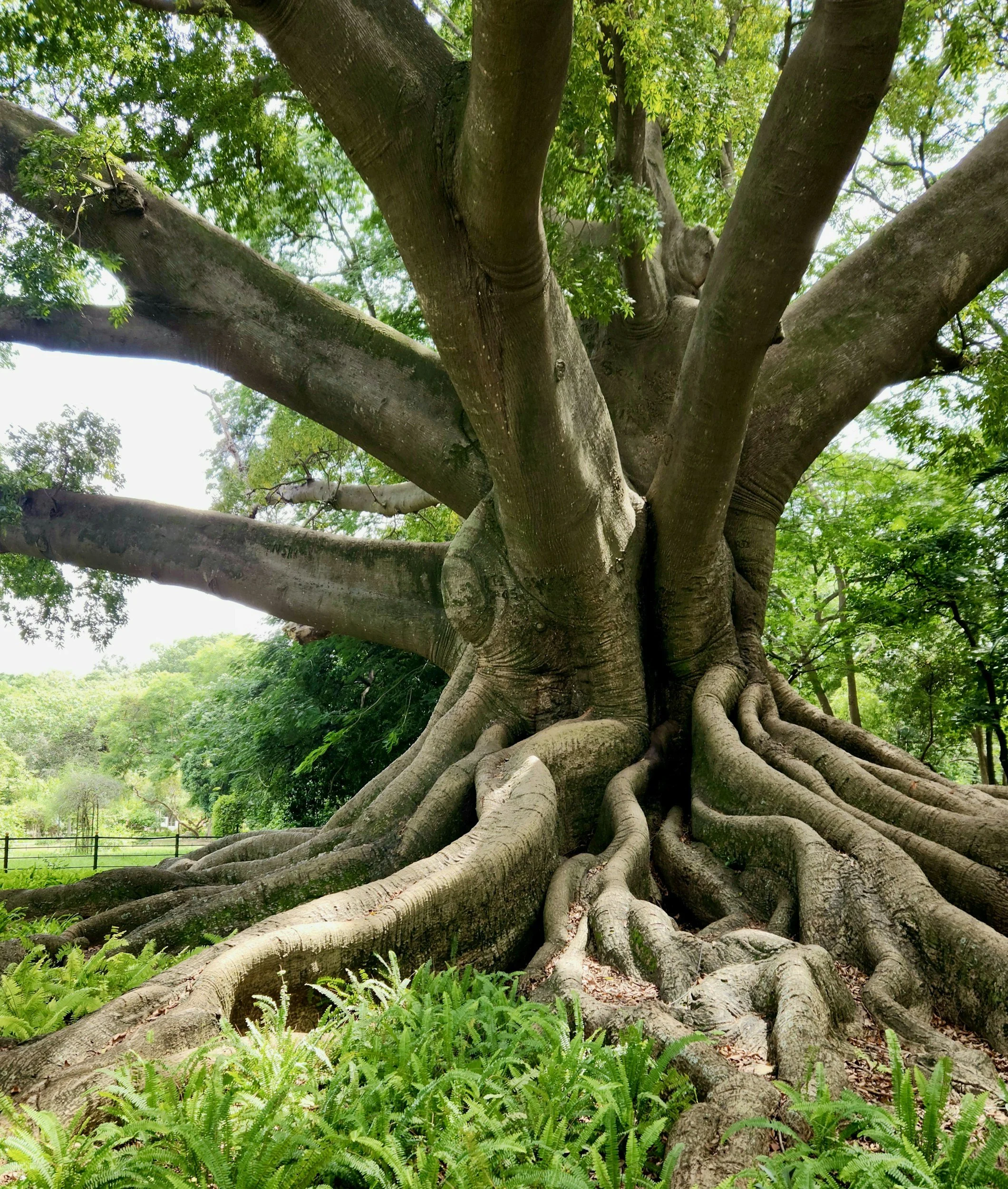
Ceiba tree
The family tree asks where you came from. These relationships ask something else entirely: how does care actually move, once you stop assuming it only flows downhill?
I find myself returning to the mangroves with that question more than any other.
The tide rises without asking permission. Juvenile French grunts slip into the shelter of the roots. Schoolmaster snappers wait in the cool lattice where larger fish can't follow them in. Oysters fasten themselves to wood that will, eventually, soften and decay and become food for something else entirely. Every incoming tide rearranges who's touching whom without ever undoing the structure itself.
Stand there long enough and the question of which root came first starts to feel almost beside the point. The shoreline isn't held up by one root. It never was. It's held by all of them, together, none of them keeping score.
The mangroves don't care about straight lines. They care about tides. About storms. About weight, and about holding.
I came looking for another way to think about family. What I found was something larger than family. Relationship itself might be one of the living world's oldest intelligences, older by far than our species. The reefs know it. The fungi know it. The dying know it, at the very end, more clearly than almost anyone. And queer people have always known it too, even when nobody handed us the word for it.
The family tree still asks me where I came from. The mangroves taught me to ask something else: who are you helping hold?
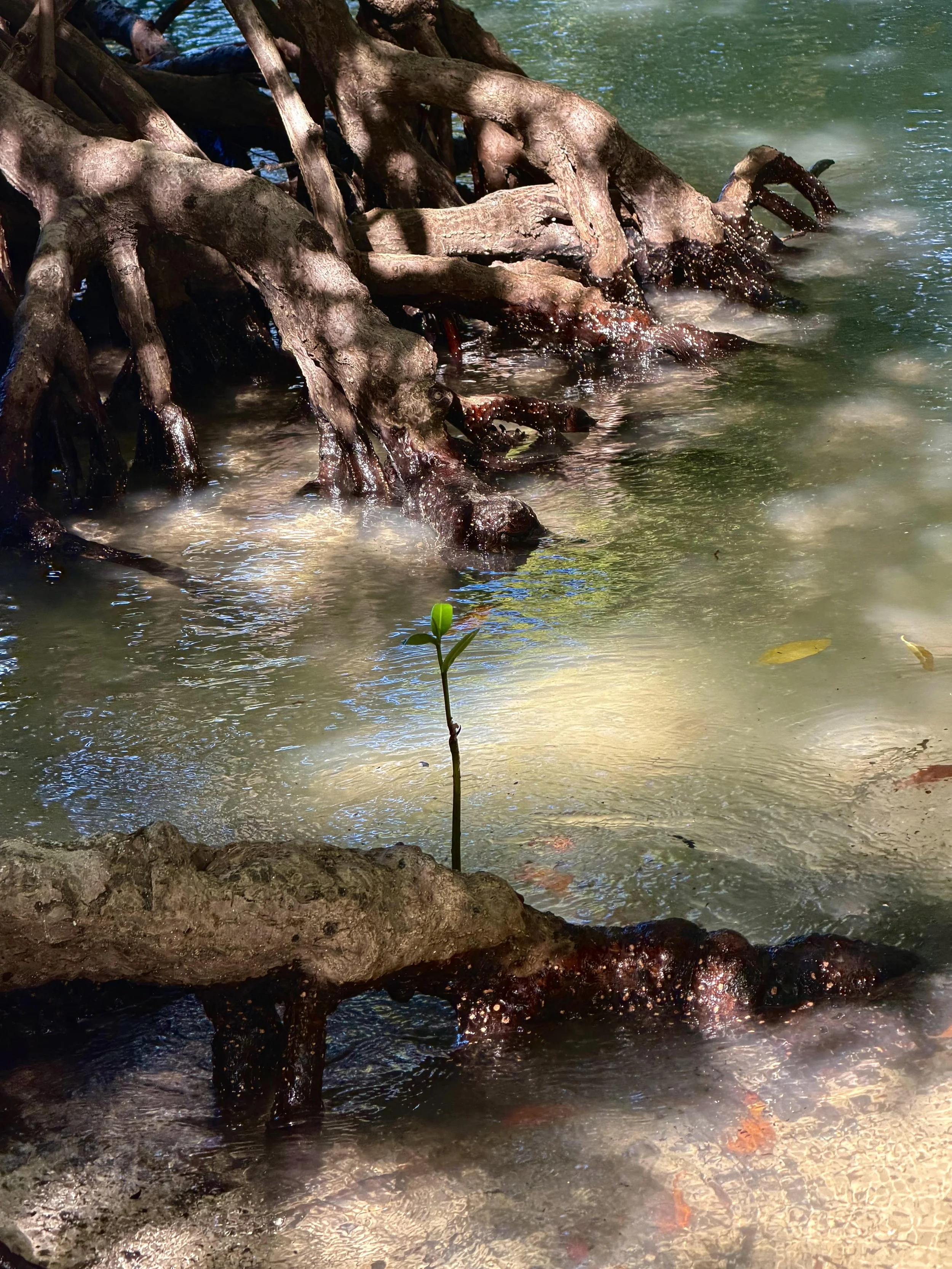
Emerging within the Mangrove, 2025
Michelle Carrera is a Puerto Rican writer, grief worker, death doula, and cultural witness exploring grief, ancestry, ecology, spirituality, and belonging in a changing world. Their work has appeared in various publications and can also be found through Grief and Liberation.
Grief and Liberation is a creative ecosystem devoted to grief, pilgrimage, ecology, ancestry, spirituality, animals, and the search for aliveness in fractured times. Through essays, stories, and reflections, it asks how we remain open-hearted in a world marked by loss and transformation. www.griefandliberation.com
Readers who would like to support this work can do so through Patreon, where Michelle shares Studio Notes, works in progress, and other writings from the edges of the creative process.