
I know what it feels like when a place is slowly leaving itself. After years of accompanying dying people, sitting at bedsides and holding grief, I’ve learned to recognize it.
I'm walking the Camino Francés, and I keep encountering that same feeling in some of the towns I have to walk through.The doors are still open, coffee and wine is still being poured but not enough bodies are there. And I know this silence almost too well. I'm from Puerto Rico.
What makes the ache stranger is that these places were built because people were expected to come. Stampedes of people, full rivers of them. As pilgrimage expanded through the eleventh and twelfth centuries, the landscape itself began rearranging around human movement. Bridges were built at dangerous crossings. Roads were carved through terrain. Towns didn't just appear spontaneously, they were created by need. Puente de la Reina exists because a bridge was commissioned by the Queen of Navarra so that pilgrims could cross safely and people would have to walk through the town. Roncesvalles came to be because broken-bodied people stumbling down from the Pyrenees needed somewhere to be received, healed, fed, held.
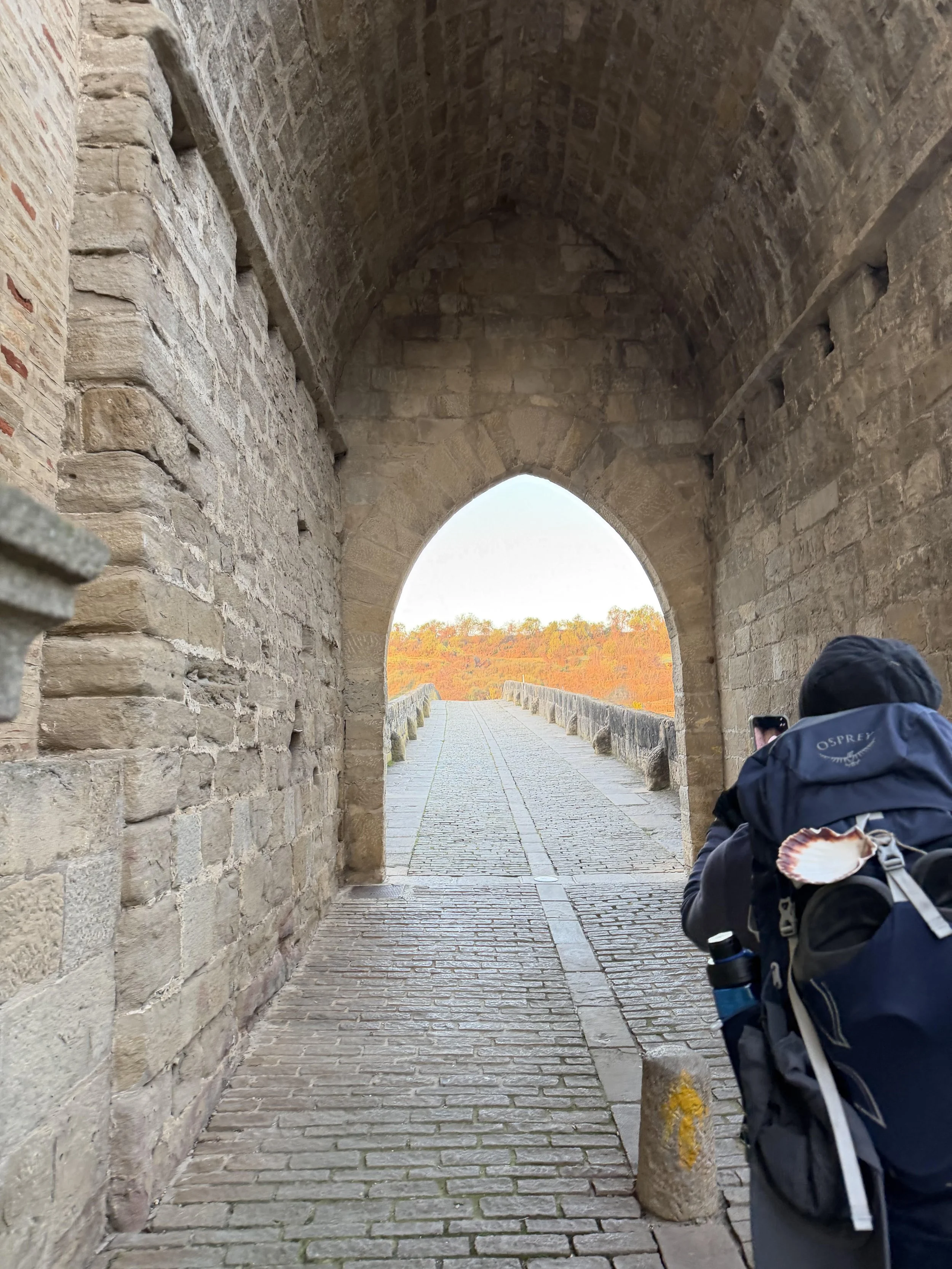
Puente La Reina
And Santo Domingo de la Calzada built roads, a bridge, and a hospital. The town grew around those acts of care the way roots gather around water. All of it, the hospitals, the albergues, the churches, they were relational architecture. They were built because people were coming, and someone decided those people deserved to arrive somewhere.
The sacred and the practical were always braided together here. Care has always needed a material form. Someone has to bake the bread, sweep the floor, repair the roof, keep the light on. I've been asking myself, as I walk, whether that exchange was always also a transaction. Whether the holy has always been entangled with the economic. I’m not asking cynically. I ask it because I have time on this road, and the question keeps coming.
The Camino is not empty now. Let me be clear about that. It is very much alive, hundreds of thousands of people move through it every year. Footsteps and languages and prayers and blisters and grief and laughter. The path hums with that electric magic.
But something else is also true, and it lives in uncomfortable proximity to that aliveness. The towns along the Camino Francés are among the most photographed villages in Europe. In the summer, on any given morning you can watch more than a hundred pilgrims pass through a place in an hour with all that entails, the pausing, snapping photos, buying a coffee, moving on. The albergue that a family ran for forty years is now managed by an app. The bar that used to serve the village serves pilgrims now, which means something different on the menu, a different rhythm, a different kind of conversation. Tourism has not saved these towns. It has, in many ways, passed through them the same way we all do, hungry, grateful, and temporary.
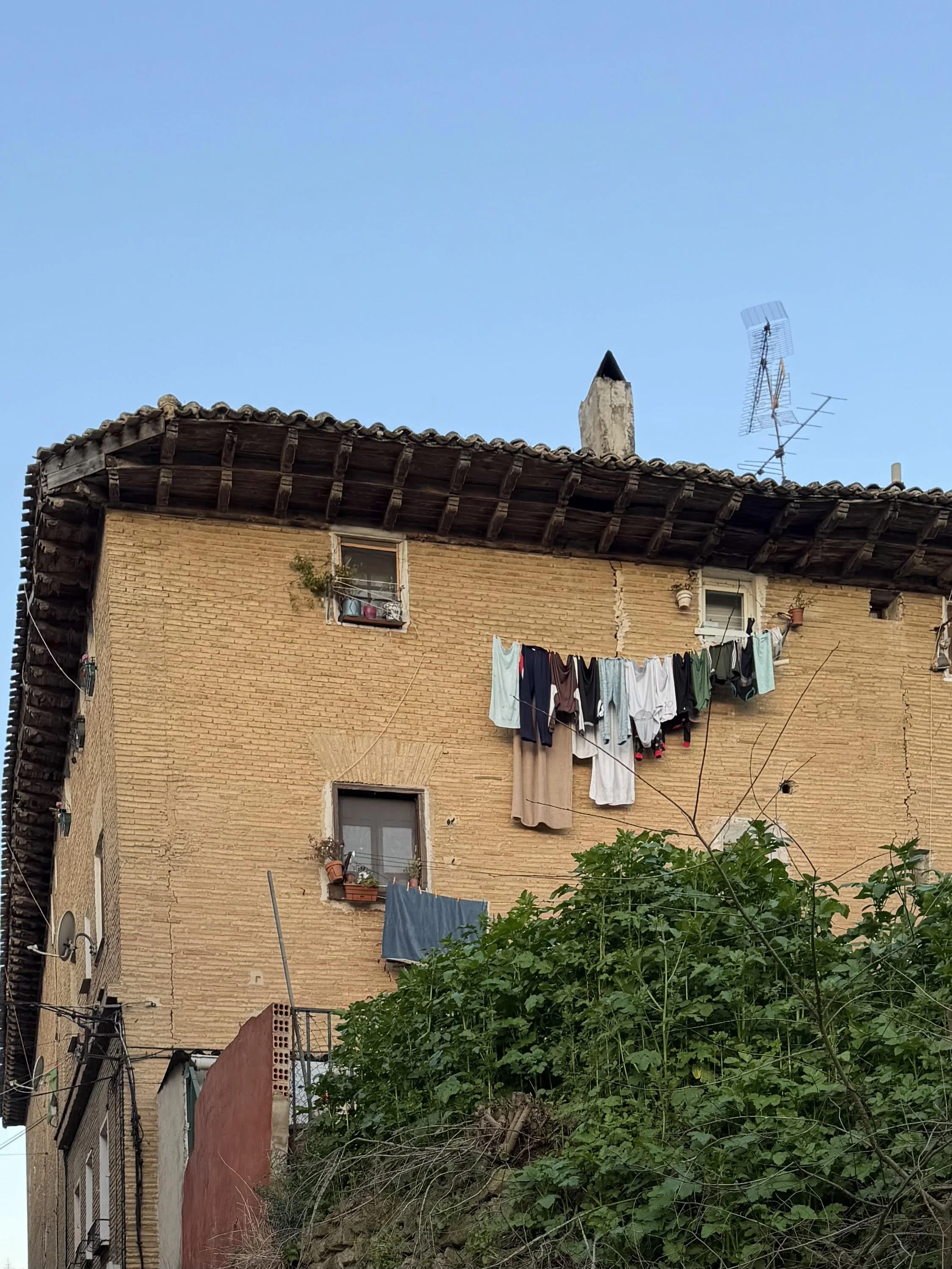
Aquí Vive Gente
And still the locals leave. The young go to wherever the future seems to be happening. The pilgrims flood in. Both things are true at once, and the vertigo of that is something I keep trying to find words for.
In one of these in-between towns, I met a man named Victorino. He was born there, he told me, with pride. And then: "No one is born here anymore. Now they go to Burgos." The beginning of life has left the village. I've heard versions of that my whole life. In Puerto Rico too, there are places where the schools close and the young leave and the future seems to happen somewhere else. The details change but the feeling does not.
In Itero de la Vega, on the Wednesday before Easter, the power went out. Just one of those things, people said. Of course my mind went immediately to Puerto Rico. Because of course it did. I come from an island that has spent years practicing darkness. An island that has been asked, over and over again, to normalize what should never have become normal. An island that has been forced to keep its electrical grid held together with prayers and political neglect and call it resilience. That shrug is really a form of grief.
Here in Itero, Blanca is retiring. Blanca is the hospitalera. I stayed at her albergue, and because it was Penitence Wednesday, she invited me to go to church with her. She volunteers there and wanted to show me the rooms that aren't open to the public, the quiet sacred spaces that tourists never see. She showed me with the tenderness of someone who has spent years tending something that most people only pass through.
She is retiring. And the small store beside her pension, the only store in town, is retiring too. There is no one coming to take either of them over. I want you to feel that absence, not just understand it. It’s more than a policy problem or a demographic statistic. It’s a tear in the fabric of a place.
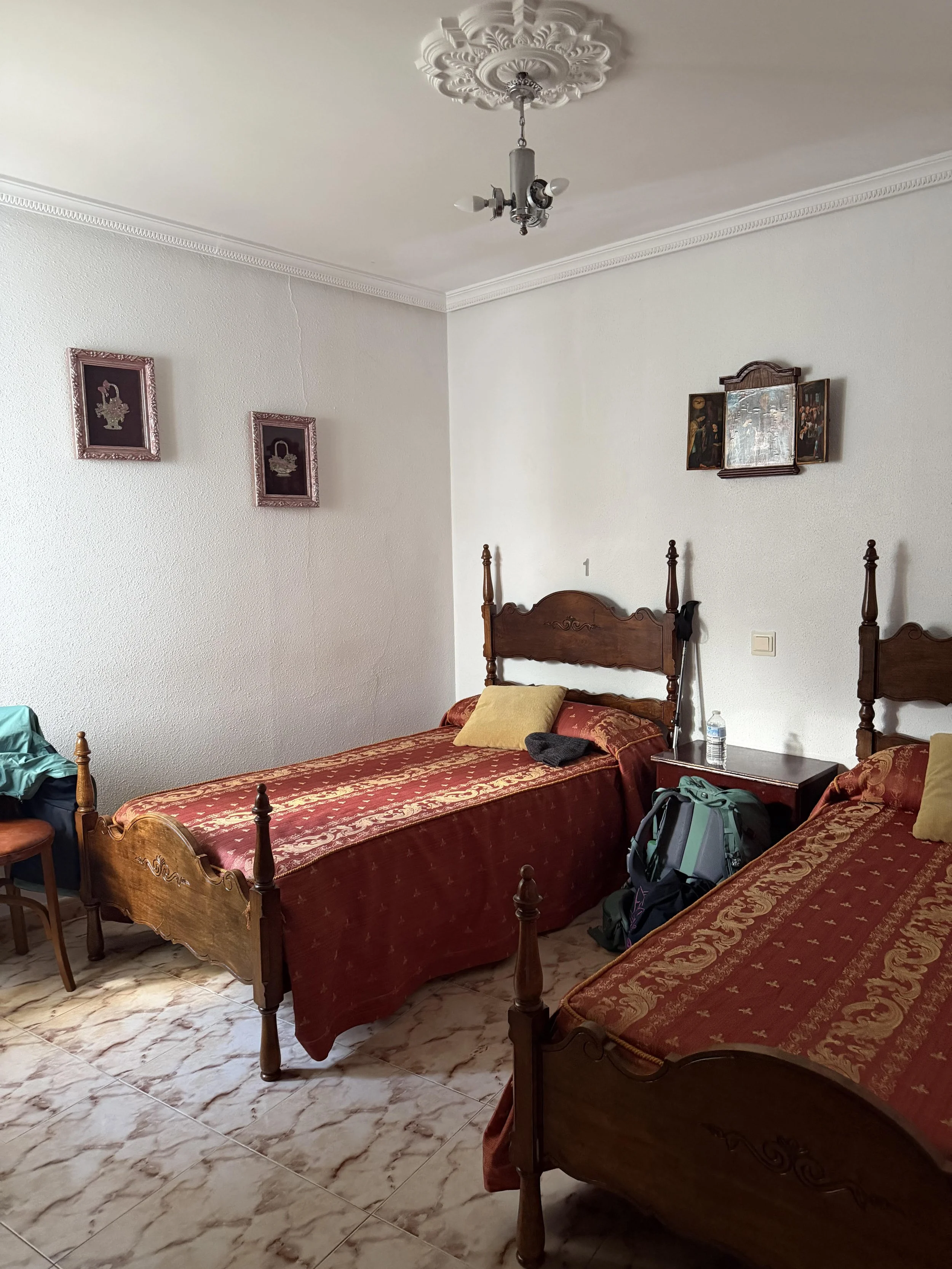
Pensión
So the system adapts, as systems do. Municipal albergues are now staffed by rotating volunteers. People arrive for a week or two, care deeply, hold the space with generosity, and then leave. Which is beautiful. And which is also not the same as staying.
Here is the contradiction I cannot stop turning over: the Camino is thriving in motion, and the places that hold it are becoming more fragile in stillness. You feel it in the empty playgrounds. There is nothing quite so unsettling as walking into a town and realizing there are no children. No bicycles, no shouting, no ball being kicked against a wall. It is a specific absence, and it is louder than you would expect. It’s almost apocalyptic. Where are the children?!
For one night, the town fills up. Backpacks pile against café walls. Pilgrims eat, drink, wash clothes, tend their blisters, and exchange stories. For a few hours the whole thing works exactly as it was designed to. Then morning comes. Everyone puts their pack back on and walks west. But what remains is carried by fewer and fewer hands.
The magic of the Camino does not belong to those of us passing through it. It lives in the ones who stay. The hospitaleros who unlock the door before sunrise. The people who refill the coffee and sweep the threshold and keep the light on long. We arrive, we receive, we leave. We get the privilege of movement. The privilege of transformation. The stories we'll carry for years about what the road taught us, about who we became out here. But they carry the road itself day after day, season after season.
I feel the discomfort of that truth in myself. I arrive. I receive. I leave. I don't fully know what it means to belong to a place the way they do. I try, I ask questions, I listen, I linger when I can, I try to leave behind something of the energy I take. But I am still passing through. And sometimes that sits heavy.
We are not the solution to what is happening to these towns. The hundreds of thousands of us who walk this road every year, we are not saving them. We are a different kind of pressure, a different kind of temporary. We need to be fed and housed and held, just as the medieval pilgrims did. But we don't stay to send our children to the village school. We don't buy the store when Blanca retires. We consume the experience and we walk away grateful, and the place is left a little more hollowed out for having hosted us so well.
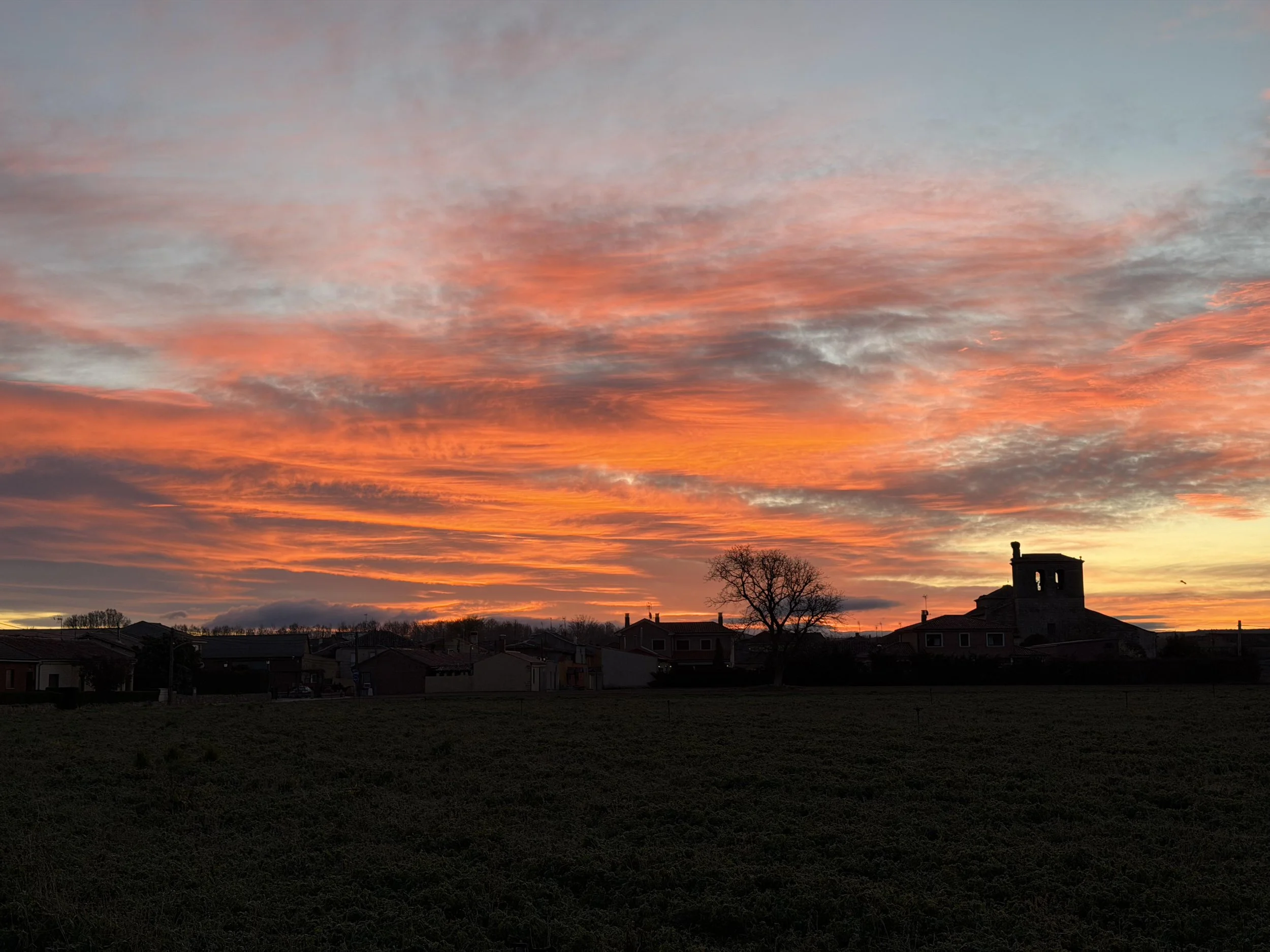
Leaving Itero De La Vega at sunrise
I think of Puerto Rico with a different kind of sadness now. The same almost-invisible labor of those who remain. There too, people flood in, tourists, cruise ships, digital nomads priced into neighborhoods that locals can no longer afford while the people who built the place keep leaving. The architecture of loss is the same.
What do we owe the ones who stay? That question has followed me across an ocean. It waits in empty schoolyards and shuttered storefronts and villages where no children are born anymore. It waited in Puerto Rico before I ever stepped onto this road. It is waiting in a hundred places I have not yet been.
Maybe that is what pilgrimage does. It takes the question you thought belonged only to one place and shows you that it lives everywhere. It makes the local into the universal without letting you escape the local. You cannot abstract your way out of Blanca's face when she showed me those church rooms, the way she touched the door like it was something she was already beginning to say goodbye to.
I don't have an answer. The road keeps asking and I keep walking, which is maybe the most honest thing I can offer right now. The answer has not caught up to me. But I am still walking toward it.
Parts of this essay first appeared in a note written from the Camino and shared with Patreon supporters. If you'd like to help sustain Grief and Liberation and receive early access to essays, reflections, and works-in-progress, you can support the work on Patreon.
Michelle Carrera is a Puerto Rican writer, grief worker, death doula, and cultural witness exploring grief, ancestry, ecology, spirituality, and belonging in a changing world. Their work has appeared in various publications and can also be found through Grief and Liberation.
Grief and Liberation is a creative ecosystem devoted to grief, pilgrimage, ecology, ancestry, spirituality, animals, and the search for aliveness in fractured times. Through essays, stories, and reflections, it asks how we remain open-hearted in a world marked by loss and transformation.